Fact Checking the Cage · Transport
Do Swiss trains really always run on time?
Of course they do. Except when it snows, the ground disappears, a wheel breaks, or reality turns up without an appointment.
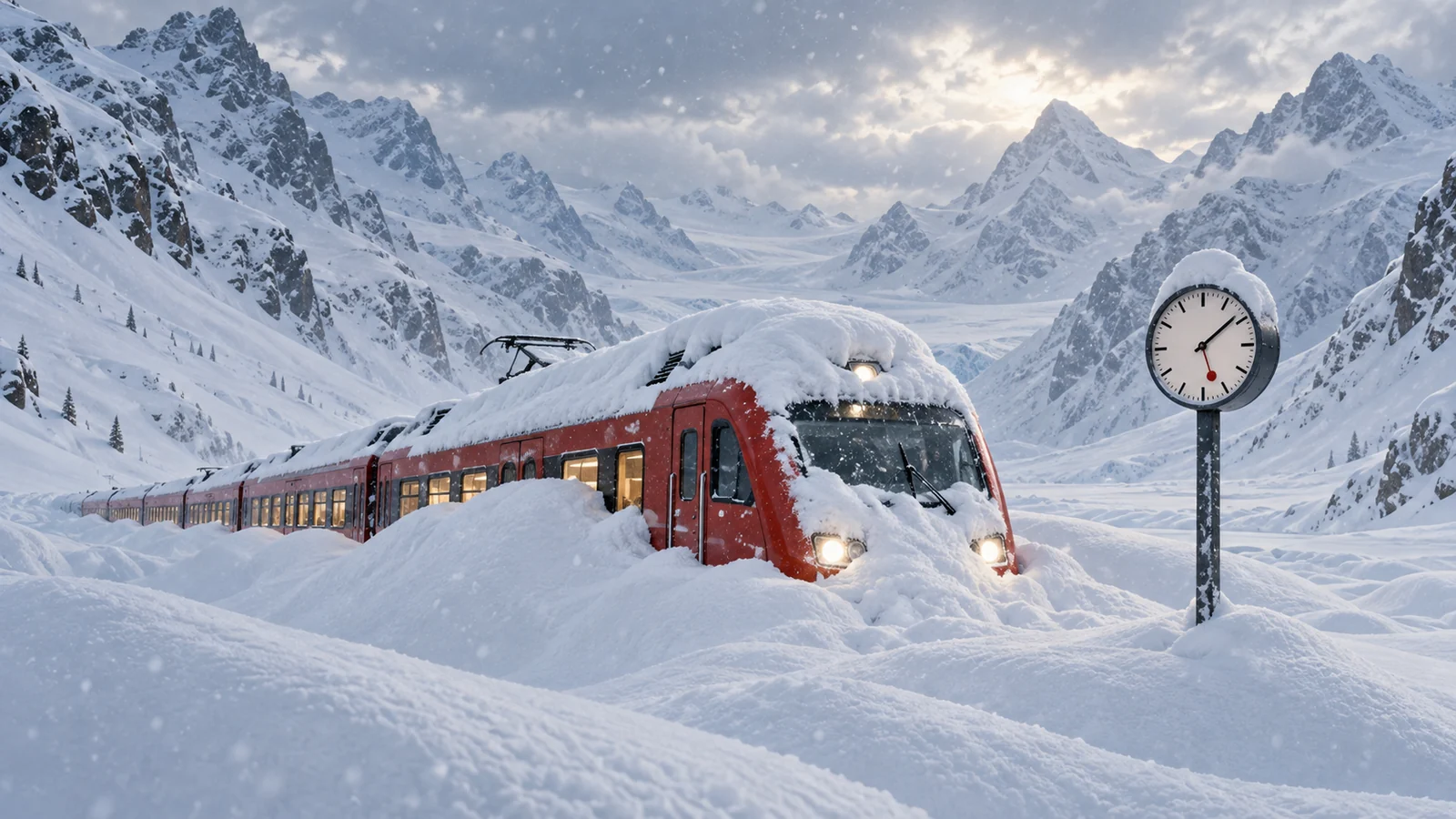
In Switzerland, time does not pass. It is measured.
The station clock is not merely an instrument. It is a moral authority. It watches as you sprint along the platform with coffee in one hand, your phone in the other, and your dignity already departed on the previous train.
The myth is known throughout the world: Swiss trains always run on time.
The short answer is: nearly.
The more interesting answer is: it depends how much reality manages to infiltrate the official timetable.
First, credit where credit is due
In 2025, 94.1% of Swiss Federal Railways passenger trains arrived on time. It was the best result SBB had ever recorded. In French-speaking Switzerland, punctuality reached 93.4%, a marked improvement on previous years.
On 28 December, possibly taking advantage of the fact that half the country was still at the dining table, the figure even reached 98.6%.
Source: SBB, 2025 punctuality figures
These are excellent results. To deny it would be unfair.
The trouble with percentages is that they do not catch the train on your behalf.
A punctuality rate of 94.1% is splendid until your service belongs to the remaining 5.9%. At that point, the statistic remains in excellent health while you stare at the words “delay of indeterminate length” on the departure board and wonder whether it is a railway forecast or an existential diagnosis.
Snow: an entirely unforeseeable event in Switzerland
Then winter arrives.
Every year.
At roughly the same time.
And yet, when the first flakes begin to fall, certain stations acquire the atmosphere of a place that has just discovered a new meteorological phenomenon.
“Snow? Here? In Switzerland? Someone alert Bern.”
SBB does, of course, prepare in earnest. It has around 400 winter-service staff, specialised equipment for clearing the tracks, and heating systems capable of keeping nearly 7,500 points operational at temperatures as low as −20°C.
Snow, however, possesses one quality rather ill-suited to Swiss administration: it does not fill in forms.
It can freeze points, rails and platforms. Ice can jam train doors and equipment. Branches weighed down by snow can fall on power lines and, in the mountains, avalanches can close entire routes.
Source: SBB, snow, ice and cold: the winter challenges
The system, then, is prepared.
It is simply that physics occasionally refuses to observe the timetable.
A few frozen points, one slow-moving train and a missed connection are enough for delays to spread through the network with almost Swiss precision.
Your train leaves seven minutes late. You miss a connection by two minutes. The next one departs half an hour later. You eventually arrive thirty-seven minutes behind schedule, but may take comfort in knowing that the entire sequence unfolded according to a perfectly organised procedure.
When the train was there, but the ground was not
In November 2021, rail services between Lausanne and Geneva were interrupted at Tolochenaz, near Morges.
There had been no exceptional snowfall.
There was no strike.
It was not even the train’s fault.
The ground beneath the tracks had disappeared.
During work beneath the railway to install a water pipe, a microtunnel encountered an area of unstable ground. Cavities formed: first a collapse at the edge of the tracks, followed by a second hole between the two lines.
The line between Morges and Allaman had to be closed. Around twenty people worked day and night, more than 25 cubic metres of concrete were used, and roughly 25 replacement buses were laid on. Normal services could not resume before Friday morning.
Source: Keystone-SDA/Radio Lac, 10 November 2021
It was a memorable moment.
Switzerland had not missed the train.
The train had misplaced Switzerland.
Naturally, everything had been studied. The tunnel ran at what was considered a sufficient depth. The first excavation had been completed without incident. The second found a pocket of exceptionally poor ground.
Even the subsoil, it appears, varies from canton to canton.
For several days, one of the most important rail links in French-speaking Switzerland depended not on timetables, signals or staff efficiency, but on the ground’s geological willingness to remain where it had been found.
A variable which, until then, had not appeared on the SBB app.
When even precision comes off the rails
Swiss trains do not merely arrive late.
Occasionally, they derail.
They do so rarely, it must be said. But when it happens, the system seems determined to compensate for the event’s infrequency with considerable logistical ambition.
On 10 August 2023, a freight train derailed inside the Gotthard Base Tunnel, the longest railway tunnel in the world and one of the Confederation’s most celebrated feats of engineering.
No one was injured, which is the most important point.
The tunnel, on the other hand, emerged with something of an identity crisis.
The derailment was caused by a broken wheel on one of the wagons. The train continued to drag the damage through the tunnel until several wagons left the rails, damaging track, points and safety infrastructure.
Seven kilometres of track had to be completely replaced. Repair costs were estimated at between CHF 100 million and CHF 130 million, and the tunnel’s full reopening was postponed until 2 September 2024, nearly thirteen months after the accident.
Sources: Swissinfo/Keystone-SDA and Railway Technology
The tunnel had been built to shorten journey times.
After the accident, many passenger services were diverted onto the old panoramic route, adding around an hour to domestic journeys and up to two hours to international ones.
A structure costing more than twelve billion francs, designed to save time, had temporarily succeeded in producing more of it.
Scenic time, naturally.
The freight train had not simply arrived late. It had rewritten the timetable of an entire part of Europe.
Here too, the Swiss response was exemplary: investigations, technical assessments, continuous repair work, inspections and a new reopening schedule.
The wheel had broken in seconds.
The procedure for explaining why took rather longer.
The Gotthard thus demonstrated a fundamental principle of Swiss efficiency: the system may be almost perfect, but it takes only one component to stop believing in it.
When an accident leaves no room for irony
Sadly, not every railway accident ends merely with a bill running into millions and passengers being obliged to admire the scenery.
On 23 July 2010, the Glacier Express derailed between Lax and Fiesch in the canton of Valais. A Japanese tourist was killed and 42 people were injured.
The investigation found that the driver had entered a section with a speed limit of 35 kilometres per hour while travelling at approximately 55.
A difference of twenty kilometres per hour: very little on a motorway, enough to turn one of the world’s most beautiful railway journeys into a tragedy.
Source: Swissinfo, “Human error caused Glacier Express crash”
Here, the irony stops.
Only one fact remains: no network, however advanced, is immune to human error, technical failure or a combination of the two.
Serious railway accidents are rare in Switzerland, but “rare” does not mean “impossible”.
It means only that, when one occurs, the country experiences it as an intolerable anomaly.
Perhaps it is precisely this intolerance of error that makes the system so safe. Every accident produces reports, new procedures, technical changes and promises that it must never happen again.
Switzerland learns from its mistakes.
Preferably after numbering, classifying and archiving them as a PDF.
There are, however, railway disruptions that are harder still to describe. They are not caused by a broken wheel, excessive speed or unstable ground.
And in those cases, the question is no longer why the train was late.
When the delay is no longer funny
There is one cause of disruption before which sarcasm must stop: suicides on the railway network.
According to figures from the Federal Office of Transport reported by Le Temps, 136 people died by suicide on Swiss railway lines in 2022. In previous years, the figure had ranged from 120 to 143 cases: on average, roughly one every three days.
These figures do not show a continuous increase. They do, however, reveal a serious, persistent problem—one far too frequent to be treated as a mere line in a traffic bulletin.
Source: Le Temps, 15 May 2024
Behind every disruption is a person, a family, railway staff, emergency workers and many unwilling witnesses.
The delayed train is merely the most visible and least important consequence.
What remains significant, however, is the way the railway system attempts to describe what has happened.
In 2024, the phrase “incident due to an external cause” was introduced to replace the more explicit “person involved in an accident” in many passenger announcements. The decision had been discussed with prevention experts and was also intended to reduce the risk of imitation.
A serious and understandable reason.
The phrase nevertheless remains a minor masterpiece of administrative neutrality.
A human tragedy becomes an “incident”.
The cause becomes “external”.
The pain remains outside the operational vocabulary.
Perhaps this is one of the deepest characteristics of the golden cage: when reality becomes unbearable, it is assigned a category.
So, do they always run on time?
No.
They run on time very often—probably more often than in almost any other country. And it is precisely that efficiency which makes every delay so startling.
In Italy, a late train is a railway event.
In Switzerland, it is a crisis of confidence in the institutions.
Five minutes is enough for passengers to begin staring at the clock. After ten, they check the app. After fifteen, an informal committee forms on the platform. After twenty, someone probably proposes a referendum.
Swiss perfection exists, but it is delicate.
It works until ice freezes a set of points, a building site discovers that the ground beneath the tracks is missing, a wheel breaks inside the world’s longest railway tunnel, or a human tragedy forces the entire network to stop.
Swiss trains do not always run on time.
It is the myth of their punctuality that arrives precisely on schedule, every time.
And when the system fails, do not worry: the delay will be analysed, classified and communicated.
Preferably in three languages.
Sources and further reading
- SBB — Record punctuality in 2025
- SBB — Snow, ice and cold: the winter challenges
- Radio Lac/Keystone-SDA — The Tolochenaz railway collapse
- Swissinfo — Damage and repair costs following the Gotthard derailment
- Railway Technology — The full reopening of the Gotthard Base Tunnel
- Swissinfo — The Glacier Express accident
- Le Temps — Railway suicides and passenger communications